"I didn't start this to chase an algorithm. I started it to stop time."
Blackwater Outdoor Journeys is a documentary archive of real canoe expeditions through the blackwater rivers of the Deep South, filmed by Rodney and Tina Thompson out of Saint George, Georgia. Unstaged, unhurried, and real.
In June 2025 I launched this channel with a single camera. After losing one of my sons, I realized how many adventures had already faded into memory, and I swore that would not happen again. What began as an archive for my family has become a record for anyone who has felt the pull of dark water and tall cypress.
I did not start this to chase an algorithm. I started it to stop time. That is still the whole point. Every trip we film is a trip that now exists somewhere other than memory, which is the one place I have already learned things can slip away. A canoe on blackwater does not care about view counts. It cares whether you read the current right, whether your camp holds through the night, whether you and the person paddling with you come home. Everything else on this site, the rivers, the gear, the field notes, grew out of that one decision to start pointing a camera at the water instead of just paddling past it.
Why this archive exists
Three reasons. For my family, so these trips outlast my memory. For the people who cannot get out there. And for the paddlers planning their own runs, so they can learn from what we got right and what we got wrong.
The first reason is the one that started everything, and it does not need dressing up. A camera does what memory cannot always do on its own. It holds a trip exactly as it happened: the light on the water at the first paddle stroke, the sound of the boat sliding off a sandbar, the exact bend in the river where the day turned hard or turned good. I am not filming these trips to perform them for anyone. I am filming them so they are still here.
The second reason grew out of the first almost by accident. Not everyone who loves this water can get to it. Health, age, distance, all of it keeps people off the river who would be out here in a heartbeat if they could. For those people, these films are a window. Somebody who cannot make the put-in this season can still feel the cypress close in around a canoe, still hear the water working against the hull, still get a few hours in the Okefenokee without leaving home. That matters to me as much as anything else this channel does.
The third reason is the most practical. Every river guide, every field note, every hard lesson we post exists so the next paddler does not have to learn it the same expensive way we did. We do not edit around our mistakes. If a route was wrong, if a camp was miserable, if the water rose faster than we planned for, that stays in the film and gets written down. Real information beats a highlight reel every time you are actually out there alone with a map and falling light.
The mission
We film real trips through the blackwater country of the Deep South and tell them the way they happened, so they outlast memory. For our family first. For the people who can't get out here. And for the next paddler standing at the put-in we once stood at.
The vision
To build the deepest film record the blackwater country has ever had. One of the biggest outdoor channels in the country, still rooted in the small-town family values of Saint George. The channel a World Heritage region points to as its voice. An archive that holds what happened and opens what's next.
Reliving what happened. Opening what's next.
What we stand by
- Honest film. No staging. Nothing doctored. Mistakes stay in the cut. If the water was high, you see it high.
- The river decides. When the river says no, we turn back. Everybody comes home. No shot is worth the boat.
- A seat in the canoe. These films are for the people who can't make the put-in. Health, age, distance. If you can't get out here, you ride with us.
- The place comes first. The swamp was here before the canoe and it will be here after. We film wildlife where it lives, at a respectful distance.
- Family in the boat. This started as a record for our family. It still is. Tina is in the canoe, not on the bank.
The water we paddle
We paddle the blackwater veins where I grew up: the Okefenokee Swamp, the Suwannee River, and the St. Marys, and lately the Satilla, Altamaha, and Withlacoochee. Some of these rivers get remembered for the state park at their edge and nothing past it. We go past it. We film the trips honestly, and we write down the field notes you need to navigate remote water, endure wet camps, and handle the fixes that keep a hard day from turning bad.
Each of these rivers has its own character, and we try to let the films show it rather than just tell it. The Okefenokee is 407,000 acres of cypress labyrinth where high water and total isolation are the same thing. The Suwannee runs white sand banks over black current down to the Gulf, gator country the whole way. The St. Marys wanders the Georgia-Florida line, dark, tidal, and winding. The Satilla stays wild and tight, full of downed trees and portages, every camp on it earned. The Altamaha is Georgia's widest river, big water with tiny islands, and it rarely gets filmed at all. The Withlacoochee is blackwater that turns clear as glass where the springs feed in, and the Alapaha disappears underground for miles before it rises again. Alligators and snakes belong to all of this water. We film them where they live, at a respectful distance, because they were here before the canoe and they will be here after it.
For those who cannot get out there, because of health, age, or distance, these films are your window to the swamp.
The systems behind every expedition
The gear, skills, and trip-planning systems we use live inside Camping Wilderness Skills.
Join the CommunityHow we film it
Unstaged and unhurried is not a slogan on this site, it is closer to a rule. The footage is real and nothing is doctored. The films are edited for the telling, not to change what happened. We do not stage moments, and we do not cut around the boring or difficult parts of a trip, because the boring and difficult parts are usually where the actual information lives. Real conditions. Earned camps. No shortcuts. If the water is high, you see the water high. If the bugs are bad, you hear us say so. That approach is slower to film and slower to edit, and it will probably always cap how much we can post in a year, but it is the only version of this channel I am interested in running.
Who's in the canoe
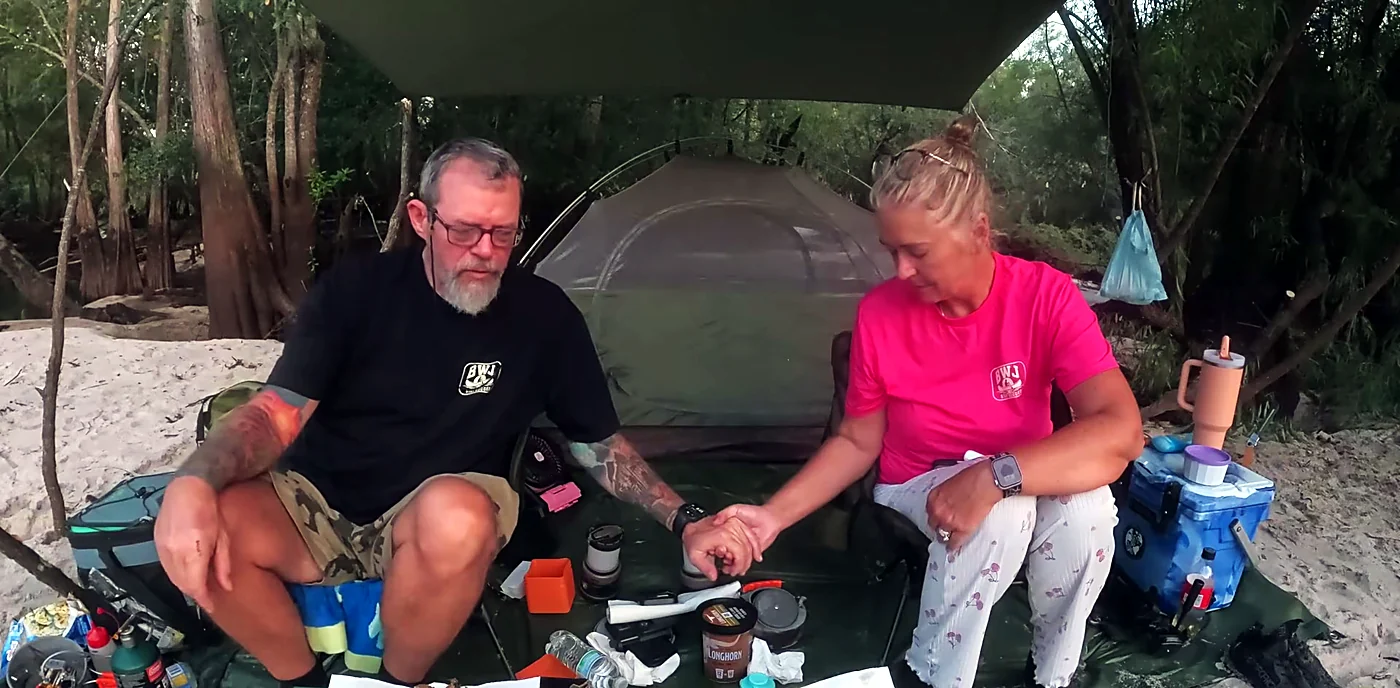
Rodney Thompson — paddler, filmmaker, and the voice behind the channel. Grew up reading these rivers before he could read a map, and that is still mostly how he navigates them, by the water itself rather than a line on a screen.
Tina Thompson — co-paddler and trip partner, up front through every gator gauntlet. She is on the water for the same trips Rodney is, not standing on a bank watching them happen.
Where the archive stands now
What started with one camera in June 2025 has grown into an archive of dozens of long-form films across eight rivers, each one built the same way: real footage, told the way it happened, paired with the field notes we wish we had before we left the put-in. None of that changes why we started. The channel exists because a canoe trip, once it is over, only survives if someone kept a record of it. We keep that record for our family first, for the people watching from somewhere they cannot paddle second, and for the next paddler standing at the same put-in we once stood at, wondering what the water is actually going to do to them. Where the map ends, the wild begins, and that is still where you will find us, camera running, paddle in the water, trying to make sure none of it fades the way those earlier trips did.