The Okefenokee Swamp: A Paddler's Guide
A vast blackwater wilderness of cypress forest and open prairie, threaded by designated water trails. The Okefenokee rewards paddlers who plan ahead, book their platforms, and paddle it on the swamp's own terms. Since July 25, 2026 the swamp is also Georgia's first UNESCO World Heritage Site.
The Okefenokee is a roughly 407,000-acre blackwater swamp and National Wildlife Refuge in southeast Georgia, a maze of cypress forest, open prairies, and tannin-dark water. Main entrances sit near Folkston on the east, Fargo and Okefenokee State Park on the west, and Kingfisher Landing to the north. Day paddling is available from the entrances; overnight trips follow designated water trails to platforms and require advance reservations and permits through the refuge. Expect a huge alligator population and confirm current rules before you go.
Where it is
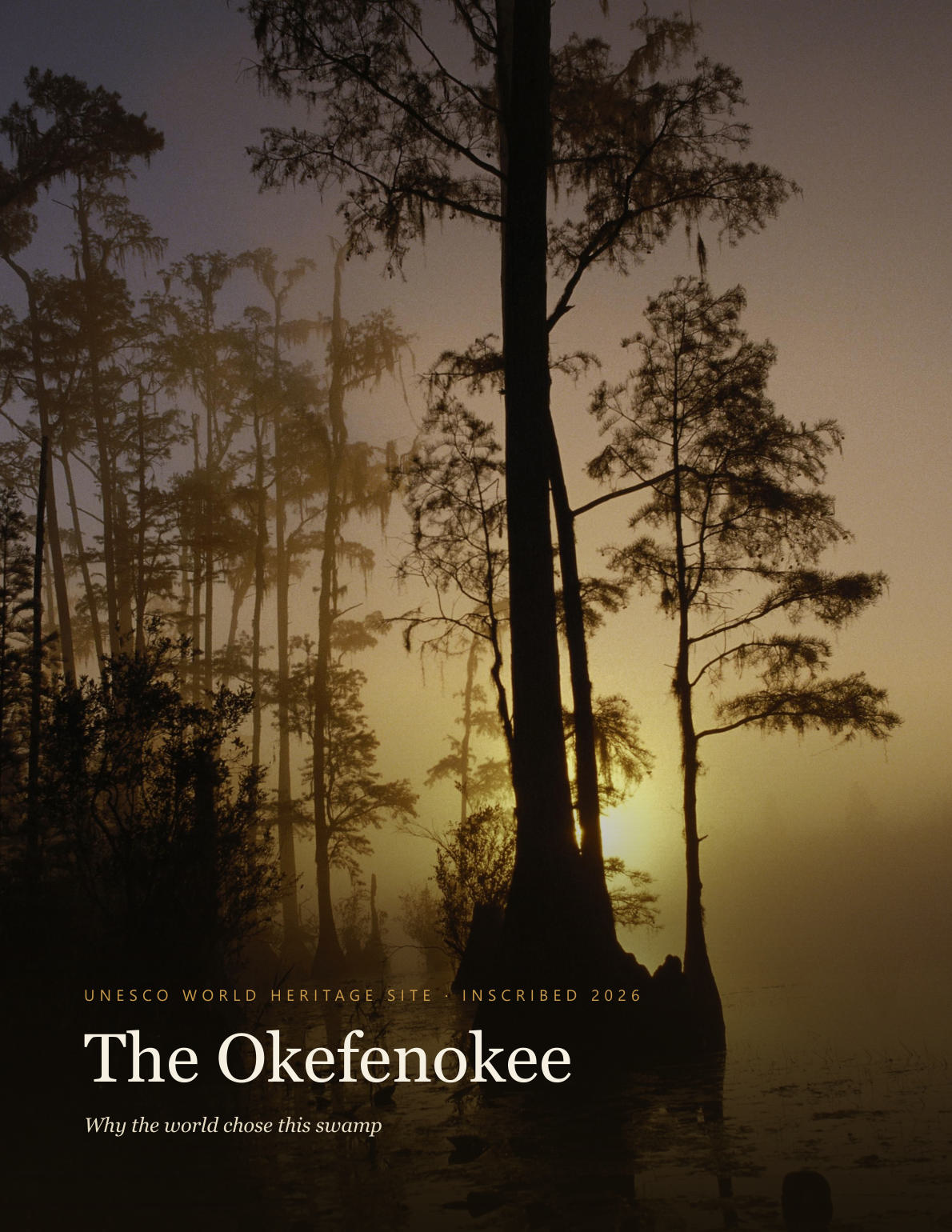
The Okefenokee Swamp lies in southeast Georgia, spilling slightly across the line into north Florida. It is a vast blackwater basin of roughly 407,000 acres, protected largely as a National Wildlife Refuge. Instead of a single channel, the Okefenokee is a mosaic of cypress forest, floating peat islands, and wide open prairies where the horizon opens up and the water reflects the sky.
The swamp is the headwaters of two rivers: the Suwannee, which drains south and west toward the Gulf of Mexico, and the St. Marys, which curls east toward the Atlantic. Getting around inside the refuge means following marked water trails rather than reading a normal river map, so distances and travel times are measured by the trail system, not by straight lines.
Access and put-ins
The Okefenokee has several main entrances, each with its own character. The east entrance near Folkston opens onto the refuge and its visitor facilities. The west side is reached through Fargo at Okefenokee State Park, a quieter gateway deep in the cypress. Kingfisher Landing to the north is a smaller launch used by paddlers heading into the interior trails.
Canoe and kayak rentals are available at some entrances, and guided options exist as well. Because the swamp is a managed refuge, launch points, hours, and available services can change seasonally. Confirm which entrance fits your trip, its current hours and launch cutoffs, and rental availability directly with the refuge or state park before you drive out.
Best time to paddle and water levels
Fall through spring is generally the most comfortable window on the Okefenokee. Cooler months bring milder temperatures and fewer biting insects than the hot, buggy stretch of high summer. Wildlife viewing stays excellent year round, but the shoulder seasons make long days on open water far more pleasant.
Water level is the variable that shapes every trip here. The swamp rises and falls with rainfall and drought, and those swings decide which trails are passable and how much you will be poling or dragging through shallow prairie. In dry spells some routes get very low; after sustained rain the swamp opens up. Confirm current water conditions and trail status with the refuge before committing to a route, and build flexibility into your plan.
Alligators and safety
The Okefenokee has a huge alligator population, and seeing them is part of the experience, not the exception. You will pass gators sunning on banks, floating in the prairies, and near the platforms where you camp. In practice they generally keep their distance, but this is genuinely wild country and respect is non-negotiable. Never feed or approach an alligator, keep food and gear secured, keep any pets out of the equation, and follow all refuge guidance for camping around wildlife.
Beyond gators, the main challenges are navigation and exposure. It is easy to lose your bearings among identical stands of cypress and open prairie, so carry a map of the trail system, a compass or GPS, and know your route. There is little to no shade in the prairies, so sun, heat, and sudden storms are real hazards. Carry more water than you think you need, wear your PFD, tell someone your route and timeline, and plan for limited cell service deep in the swamp.
Permits and rules
Overnight travel in the Okefenokee is tightly managed to protect the wilderness and to keep paddlers safe. Multi-day canoe trips follow designated water trails to a system of platforms and shelters, and every overnight trip requires advance reservations and permits through the refuge. Space is limited and popular dates fill early, so this is a trip you plan weeks or months ahead, not on a whim.
Booking is typically handled through the refuge or the recreation.gov reservation system. Fees, cancellation policies, group size limits, and trail rules all apply, and they can change. Do not treat any specific fee or itinerary you read secondhand as final. Confirm current reservation procedures, costs, and regulations directly with the refuge or recreation.gov before your trip, follow all posted rules, and practice Leave No Trace so this wilderness stays intact for the next paddler.
Our trips on the Okefenokee
We have paddled and camped deep in the Okefenokee. Watch the expeditions to see the real conditions: the cypress corridors, the open prairies, the platform camps, and the alligators as they actually are.
Field notes from the Okefenokee
Every trip we have filmed on this river, written up: what the water was doing, where we camped, and what we would do differently.
Go deeper
River levels
The USGS gauge for every river we paddle, and what the reading actually means for a loaded canoe.
The Canoe Camping Playbook
Our step-by-step course on planning, packing, and running multi-day blackwater canoe trips. Everything behind an expedition like the Okefenokee.
Camping Wilderness Skills
The community, courses, and app behind every trip we run. Trade notes with other paddlers who run these waters. A hobby community on Skool.
Okefenokee expedition films
See the cypress corridors, platform camps, and wildlife in the films we made on these waters.
Trips, unpacked
Browse the Field Notes for the decisions, gear, and lessons behind real blackwater trips.
Free Paddler's Guide
Get the complete river-planning guide for the Okefenokee and Southeast Georgia waters.
Plan the trip: Okefenokee 1-Night: Suwannee Canal to Cedar Hammock. Day by day, with food, water, gauge and permit notes.
Rivers Nearby
Suwannee
White sand banks, black current, gator country.
GA-FL lineSt. Marys
Dark, tidal, winding. The border nobody maps right.
Wild & tightSatilla
Downed trees, portages, camps you earn.
Georgia's widestAltamaha
Big water, tiny islands, the river nobody films.
Spring-fed & clearWithlacoochee
Blackwater that turns clear as glass over the springs.
Sinks & risesAlapaha
Blackwater that vanishes underground, then rises again.
Frequently asked questions
Where is the Okefenokee Swamp?
The Okefenokee Swamp lies in southeast Georgia, spilling slightly across the line into north Florida, and is protected largely as a National Wildlife Refuge. Rather than a single river channel, it is a vast blackwater basin of roughly 407,000 acres, a mosaic of cypress forest, floating peat islands, and wide open prairies where the horizon opens up and the water reflects the sky. The swamp is the headwaters of two rivers: the Suwannee, which drains south and west toward the Gulf of Mexico, and the St. Marys, which curls east toward the Atlantic. Main entrances into the refuge include Folkston on the east side, Fargo and Okefenokee State Park on the west side, and Kingfisher Landing to the north. Getting around inside the refuge means following marked water trails rather than reading a normal river map, since distances and travel times are measured by the trail system rather than by straight lines across the swamp.
Do I need a permit to canoe camp in the Okefenokee?
Overnight travel in the Okefenokee is tightly managed, both to protect the wilderness and to keep paddlers safe. Multi-day canoe trips do not wander freely; they follow designated water trails to a system of platforms and shelters, and every overnight trip requires advance reservations and permits through the refuge. Space on those platforms is limited, and popular dates fill early, so this is a trip planned weeks or months ahead, never on a whim. Booking is typically handled through the refuge itself or through the recreation.gov reservation system. Fees, cancellation policies, group size limits, and trail rules all apply, and any of them can change season to season, so no specific fee or itinerary read secondhand should be treated as final. Current reservation procedures, costs, and regulations should be confirmed directly with the refuge or recreation.gov before the trip, all posted rules should be followed, and Leave No Trace practiced so this wilderness stays intact for the next paddler.
Are there alligators in the Okefenokee?
Alligators are part of the Okefenokee experience, not the exception to it. The swamp holds a huge population, and paddlers regularly pass them sunning on the banks, floating out in the open prairies, and resting near the platforms where canoe campers spend the night. In practice they generally keep their distance from people, but this is genuinely wild country, and respect for that fact is non-negotiable. The refuge's own guidance is straightforward: never feed or approach an alligator, keep food and gear secured at all times, and keep pets out of the equation entirely. Beyond the alligators themselves, the swamp presents other hazards worth planning around, including easy disorientation among identical stands of cypress and open prairie, and long stretches of open water with little to no shade. Carrying a map of the trail system, a compass or GPS, and more water than seems necessary, wearing a PFD, and sharing a route and timeline with someone before departure are all part of paddling here responsibly.
When is the best time to paddle the Okefenokee?
Fall through spring is generally the most comfortable stretch to paddle the Okefenokee, bringing milder temperatures and far fewer biting insects than the hot, buggy stretch of high summer. Wildlife viewing holds up well year round, but the shoulder seasons make long days out on open water considerably more pleasant for paddlers. Water level, more than the calendar, is really what shapes any given trip here. The swamp rises and falls with rainfall and drought, and those swings decide which trails stay passable and how much time gets spent poling or dragging a canoe through shallow prairie instead of paddling it. In dry spells, some routes get very low, and after sustained rain, the swamp opens back up again. Because conditions shift with the weather rather than the season alone, current water conditions and trail status should be confirmed with the refuge before committing to a specific route, and flexibility should be built into any trip plan.
Can I day paddle the Okefenokee without an overnight permit?
Day paddling on the Okefenokee does not require any overnight permit and is available from the refuge's entrances. Canoe and kayak rentals are available at some of those entrances, and guided options exist as well for paddlers who want them. The entrances themselves each have a different character: Folkston on the east side opens onto the refuge and its visitor facilities, Fargo and Okefenokee State Park on the west side offer a quieter gateway deep in the cypress, and Kingfisher Landing to the north is a smaller launch mainly used by paddlers heading into the interior trails. It is overnight trips into the interior, following designated water trails to platforms and shelters, that require advance reservations and permits through the refuge. Because the swamp is a managed refuge, launch points, hours, and available services can change seasonally, so hours, launch cutoffs, and rental availability should be checked directly with the entrance being used before heading out.