 FOR KIDS
The Blackwater Southern River Fishing Guide
How to read a southern river and fish it, with the rules for six states side by side.
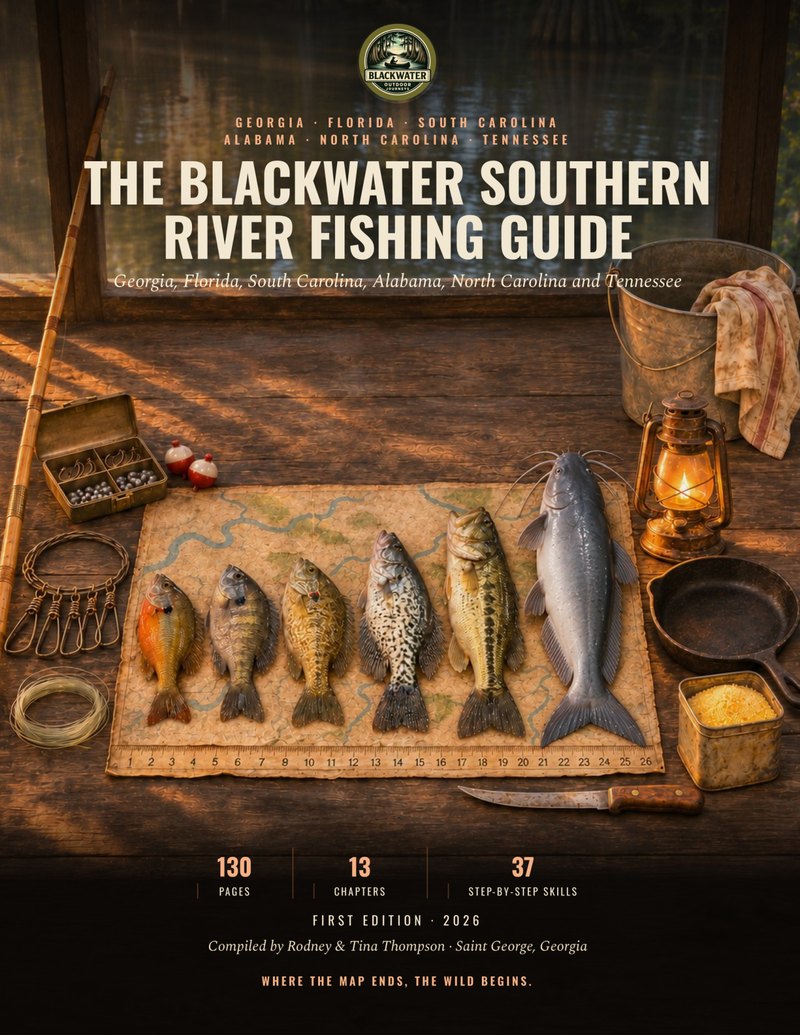
A fishing day on a southern river gets decided before the first cast: the gauge, the water temperature, the season and the rules for the water you are on. This book starts there, then reads blackwater, finds your river on the map, and takes bream, redbreast and redear, crappie, catfish and bass one at a time. Where the law differs, each chapter lays Georgia, Florida, South Carolina, Alabama, North Carolina and Tennessee side by side, read from each state’s own wildlife agency, and every chapter shows the same skill in the Camping Wilderness Skills app.
- 12 chapters, from how a fishing day gets decided to fishing with your crew and kids, plus field cards
- State tables for licenses, free fishing days, creel and size limits, trotlines, limb lines and jugs, and life jacket laws
- Reading blackwater: river gauges, water temperature, tannin, oxbows and low water
- Bream, redbreast and redear, crappie, catfish and bass, each in its own chapter
- Every rule, number and safety step names its source: 230 sources listed in the back
- An In the CWS app panel in every chapter: the same skill in the app, Free or Premium
Read a free sample
The first 6 pages open right here. One email opens the whole guide, and the same email opens every other Blackwater guide too.
What is inside: 12 chapters and the field cards
The book starts with how a fishing day gets decided, then takes the water and the fish one at a time. Where the law differs, each chapter lays Georgia, Florida, South Carolina, Alabama, North Carolina and Tennessee side by side.
- Chapter 1: How a Fishing Day Gets Decided. You can check river level, water temperature, and season in that order, then treat moon information with the right level of doubt.
- Chapter 2: Your River on the Map. You can find a public access system, match an access point to a gauge, and recognize when a border-water agreement changes the license check.
- Chapter 3: Licenses and the Rules. You can identify the license baseline, freshwater boundary note, and free-fishing information for the state and water you plan to fish.
- Chapter 4: Reading Blackwater. You can explain the color and basic water character of a blackwater stream, read a USGS gauge without mistaking stage for depth, and choose a safer bank or channel check at high or low water.
- Chapter 5: Bream, Redbreast and Redear. Identify common sunfish, use habitat and water temperature as spawning clues, match a bait to the fish and reach, and check the correct state limit before keeping one.
- Chapter 6: Crappie. Tell black crappie from white crappie, use temperature, current, cover, and the named river forecast as search clues, and apply the correct state and waterbody limit.
- Chapter 7: Catfish. Choose a catfish method that the water allows, mark and check every set correctly, and respond lawfully when a fish may be invasive.
- Chapter 8: Bass. Identify largemouth bass, keep shoal and Suwannee names tied to the waters that use them, and apply the correct bass limit, size rule, and closed-water rule.
- Chapter 9: Gear, Knots and Rigs. Set up a simple rod and bait system that fits the water, the fish, and the rule for the state you are standing in.
- Chapter 10: Safe on the Water. Launch with the right flotation gear, leave the water before lightning reaches you, and recognize the low-head dam that may not look like a dam.
- Chapter 11: Keep, Clean, Eat. Check the legal limit, protect a released fish, keep a harvest cold, and read the current advisory for the exact water before eating.
- Chapter 12: Fishing With Your Crew and Kids. Build a legal, calm fishing day for a mixed crew by checking each angler’s license status, the free-fishing date, the water rule, and the child’s safety plan.
- Field Cards. Carry compact knot, species, and state-limit cards that help you tie, identify, measure, and decide before you keep a fish.
The CWS app: the same skills on your phone
The Camping Wilderness Skills app plans river trips with USGS river gauges, offline maps and GPS tracking that works without cell service. Every chapter of this book ends with an In the CWS app panel that shows the same skill in the app, Free or Premium.
- Chapter 1, How a Fishing Day Gets Decided (Free, with offline satellite maps in Premium) If you will fish a river from a boat, plan it as a paddling trip and choose the route.
- Chapter 2, Your River on the Map (Free, with offline satellite maps in Premium) Use the trip planner to place the route, launch, and landing on the map.
- Chapter 3, Licenses and the Rules (Free, with offline satellite maps in Premium) Use a fishing trip plan to record the water, route, group, and gear.
- Chapter 4, Reading Blackwater (Free, with offline satellite maps in Premium) Open the river gauge panel for a paddling reach where a USGS gauge exists.
- Chapter 5, Bream, Redbreast and Redear (Free, with offline satellite maps and the AI Coach in Premium) Choose Fishing in the trip planner and answer the guided questions about your route, group, gear, and experience.
- Chapter 6, Crappie (Free, with offline satellite maps and the AI Coach in Premium) Use the fishing trip planner to record the route, gear, and experience that shape the trip plan.
- Chapter 7, Catfish (Free, with offline satellite maps and the AI Coach in Premium) Choose Fishing in the trip planner and record the route, group, gear, and experience.
- Chapter 8, Bass (Free account, one trip a month) Choose Fishing in the trip planner and answer the guided questions about the route, group, gear, and experience.
- Chapter 9, Gear, Knots and Rigs (Free, with offline maps in Premium) Start a fishing trip and use the guided plan to record who is going, what you are carrying, and the gaps to solve before launch.
- Chapter 10, Safe on the Water (Free, with offline maps in Premium) Build a fishing or paddling trip plan around your crew, route, gear, weather, and skill gaps.
- Chapter 11, Keep, Clean, Eat (Free, with offline maps in Premium) Use a fishing trip plan to keep the route, crew, and return plan together, with a 7-day forecast for your exact coordinates.
- Chapter 12, Fishing With Your Crew and Kids (Free, with offline maps in Premium) Start a fishing trip plan with the people who are going, their experience, and what you are carrying.
Common questions
How do you decide whether to go river fishing today?
Use the current rule for the water you will fish. Do not turn a general season statement into permission for every reach. Chapter 1, How a Fishing Day Gets Decided, shows how to check river level, water temperature, and season in that order, then treat moon information with the right level of doubt.
How do you find public access and fishing water on a southern river?
Use only the access point and gauge details printed in the river entry. Do not fill a missing field from memory. Chapter 2, Your River on the Map, shows how to find a public access system, match an access point to a gauge, and recognize when a border-water agreement changes the license check.
What fishing license do I need in Georgia, Florida, South Carolina, Alabama, North Carolina or Tennessee?
The state table summarizes the agency rules as of this printing. Check the current agency rule before every trip. Chapter 3, Licenses and the Rules, shows how to identify the license baseline, freshwater boundary note, and free-fishing information for the state and water you plan to fish.
How do you read a blackwater river for fishing?
Read the gauge named for your reach. Stage is measured from an arbitrary zero, so it is not a depth. Chapter 4, Reading Blackwater, shows how to explain the color and basic water character of a blackwater stream, read a USGS gauge without mistaking stage for depth, and choose a safer bank or channel check at high or low water.
How do you catch bream, redbreast and redear on a river?
A sunfish limit is a state and waterbody question. Check the row before you keep the fish. Chapter 5, Bream, Redbreast and Redear, shows how to identify common sunfish, use habitat and water temperature as spawning clues, match a bait to the fish and reach, and check the correct state limit before keeping one.
How do you catch crappie in a river?
Crappie limits can change by state, region, reservoir, and connected river reach. Match the waterbody before you measure. Chapter 6, Crappie, shows how to tell black crappie from white crappie, use temperature, current, cover, and the named river forecast as search clues, and apply the correct state and waterbody limit.
Are trotlines, limb lines and jugs legal for catfish?
A catfish device is legal only when its state, waterbody, marking, bait, hook count, and check schedule all match. Chapter 7, Catfish, shows how to choose a catfish method that the water allows, mark and check every set correctly, and respond lawfully when a fish may be invasive.
How do you fish for bass on a southern river?
Bass rules belong to a species and a waterbody. Check the creel, length, and closed-water lines together. Chapter 8, Bass, shows how to identify largemouth bass, keep shoal and Suwannee names tied to the waters that use them, and apply the correct bass limit, size rule, and closed-water rule.
What knots and rigs do you need for river fishing?
Count the gear for this water before you fish it. A baitfish and a hook are both part of the rule. Chapter 9, Gear, Knots and Rigs, shows how to set up a simple rod and bait system that fits the water, the fish, and the rule for the state you are standing in.
How do you stay safe fishing on a river?
Wear the PFD, leave for shelter when thunder is nearby, and treat every low-head dam as a no-go hazard. Chapter 10, Safe on the Water, shows how to launch with the right flotation gear, leave the water before lightning reaches you, and recognize the low-head dam that may not look like a dam.
How do you know which fish you can keep and eat?
Check the fish against the exact water rule, then check the exact advisory before you eat it. Chapter 11, Keep, Clean, Eat, shows how to check the legal limit, protect a released fish, keep a harvest cold, and read the current advisory for the exact water before eating.
When are the free fishing days, and do kids need a fishing license?
Write the age, method, state, water, and date before the first cast. The child’s license rule and the boat’s safety rule are separate checks. Chapter 12, Fishing With Your Crew and Kids, shows how to build a legal, calm fishing day for a mixed crew by checking each angler’s license status, the free-fishing date, the water rule, and the child’s safety plan.
What is the CWS app?
The Camping Wilderness Skills app plans river trips with USGS river gauges, offline maps and GPS tracking that works without cell service. Every chapter of The Blackwater Southern River Fishing Guide ends with an In the CWS app panel that shows the same skill in the app.
Which states does The Blackwater Southern River Fishing Guide cover?
Georgia, Florida, South Carolina, Alabama, North Carolina and Tennessee. Where the law differs, each chapter lays the six states side by side, read from each state's own wildlife agency.
Keep reading
Camping Wilderness Skills
River gauges, offline maps and trip planning, the app every chapter is built around.
Paddle itThe Blackwater Paddler's Guide: Georgia Edition
Put-ins, take-outs and gauges for Georgia rivers.
Hunt itThe Blackwater Deer Hunting Guide
The same six states, the same way, for deer season.